
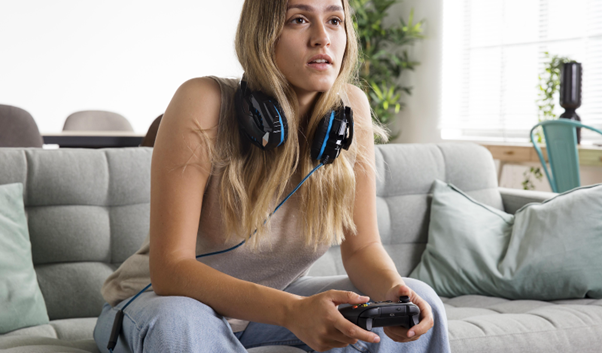
When people think of gaming, they often picture teenage boys sitting in their bedrooms with controllers in hand. However, the industry landscape has changed significantly since the COVID-19 pandemic.
During the pandemic lockdowns, gaming saw a surge in popularity, with women making up 48% of over two million daily users worldwide.
Despite this growing equality in players, sexism in gaming remains a persistent issue. If almost half of gamers are women, why does misogyny still shape gaming culture?
A study by Women in Games surveyed 500 British women and girls who play games, asking them about their experiences.
Shockingly, 14% had received threats of rape from a male player. From blatant sexism to small patronising comments, the gaming industry suffers a huge problem with harassment.
Over 30% of women suggested they prefer to mute their mics as they fear abuse from men. As a result, many women avoid voice chat altogether, limiting their ability to fully participate in online gaming communities.
Aware of the overt sexism and aggressive threats they may face, often from complete strangers, women are also retreating to female-only lobbies. These can create a safe haven where women can play without fear of unwanted sexist comments.
Another common problem is that most game protagonists are male characters created by male graphic designers. This has historically given women fewer gaming role models to look towards.
This lack of representation extends to the industry as well, with fewer than 30% of game designers being women.
Women are campaigning themselves, such as Carol Shaw, a key advocate for equality in gaming.
Shaw was the first female game designer; her game River Raid avoided gendered characters or themes, basing her protagonists purely on skill.
Her legacy proved that the games and the people who design them do not have to be masculine to be successful.
Many problems of misogyny in gaming may stem from the stereotypical notion that games are a male sphere.
When I was young, I often enjoyed playing PlayStation games with my older brother, including Need for Speed, Minecraft and Lego Star Wars.
But when Christmas came around, the games under the tree were always addressed to him. Even though I enjoyed playing just as much as he did, he was considered the ‘real’ gamer.
As a young girl, I often had to prove my knowledge of the games, so I wasn’t considered a ‘fake’ gamer, unlike the boys who automatically own this title.
While I was playing with female dolls, prepping me to be a mother, my brother was playing games where (often sexualised) women play the ‘damsel in distress’ role, prepping him to be a protector.
As such, games mirror traditional roles of men and women; they sadly also reflect the misogyny which is so rife in our society.
To tackle this issue, Dove has launched a campaign titled ‘Real Beauty’. The beauty brand is training developers and artists to create virtual women who represent the women who play the games.
By making the women on screen look more realistic, it reduces the impact of seeing such ‘perfect’ women on gamers’ self-esteem.
So, what is being done for women who are experiencing harassment in the gaming industry?
One initiative is the campaign ‘Let’s Talk About Games: She Plays, He Says’. Its first main aim is to raise awareness among parents and young people about misogyny and harassment in gaming spaces.
It focuses on educating players about what exactly constitutes sexual harassment online and promotes safer environments for women and girls in the gaming community.
Gaming audiences are more diverse than ever, but the culture is still catching up.
Until harassment, gatekeeping and stereotyping are addressed, many women will continue to feel like outsiders in spaces they should be able to enjoy.
Although initiatives have been made, petitions have been signed, and victims have spoken up, there is still a long way to go to reach equality.
Image credit: freepik


Leave a Reply